Joint Comprehensive Plan of Action (JCPOA)
Why it Matters?
Amid heightened US-Israel military strikes on Iran’s nuclear sites, calls are growing for negotiating a successor to the JCPOA to control Iran’s enriched uranium stockpile and prevent nuclear escalation in the region.
What You Should Know?
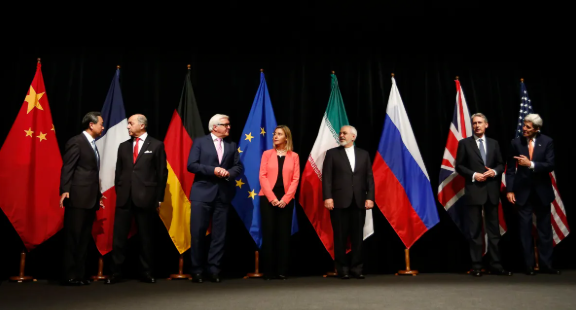
The JCPOA was signed in July 2015 between Iran and P5+1 (U.S., U.K., France, Russia, China, and Germany), along with the European Union (EU).
The deal aimed to curb Iran's nuclear program in return for sanctions relief worth billions of dollars.
Its primary goal was to prevent Iran from acquiring nuclear weapons and reduce regional tensions with rivals like Israel and Saudi Arabia.
The JCPOA sought to ensure a breakout time of at least one year if Iran decided to pursue a nuclear weapon.
It addressed global fears that a nuclear-capable Iran could trigger a Middle East arms race.
Key Provisions:
Uranium enrichment is capped at 3.67%, well below the 90% weapons-grade threshold.
Use of only 5,060 Iranian Centrifuge-1 (IR-1) centrifuges permitted at the Natanz nuclear facility for 10 years.
The Arak heavy-water reactor was redesigned to block weapons-grade plutonium production.
Enriched uranium stockpile limited to 300 kg, reduced from over 10,000 kg.
International Atomic Energy Agency (IAEA) inspectors granted enhanced access through the provisional implementation of the Additional Protocol.
Continuous monitoring systems are installed at key facilities like Natanz and Fordow.
Research and development on advanced centrifuges are restricted for a fixed duration.
Upon compliance, US, EU, and UN sanctions were lifted, enabling access to frozen assets and global trade.