Great Indian Hornbill
Why it Matters?
The rare coastal sighting of the endangered Great Hornbill in Ezhimala, Kerala, signals the region’s unexpected ecological richness and calls for renewed conservation attention.
What You Should Know?
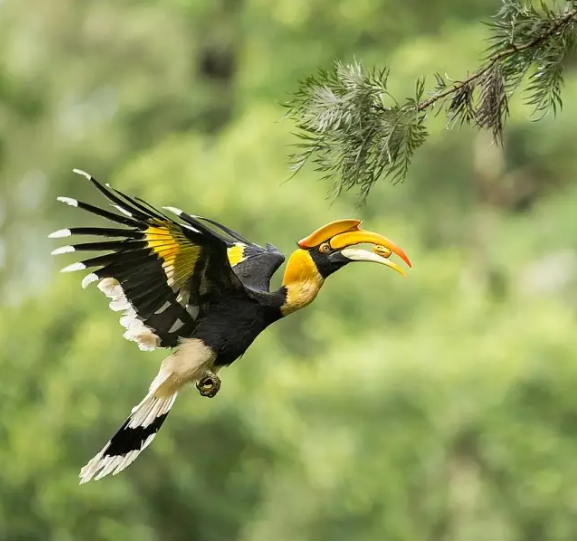
The Great Indian Hornbill, also called the Concave-Casqued Hornbill or Great Pied Hornbill, is one of the largest members of the hornbill family.
It is primarily found in evergreen and moist deciduous forests across the Western Ghats, Northeastern states, and the Himalayas, thriving in the canopy of tall trees.
India is home to nine hornbill species, with the northeast showing the highest diversity.
The Great Hornbill is the state bird of both Arunachal Pradesh and Kerala.
It plays a vital ecological role as a seed disperser, earning titles like “forest engineer” or “farmer of the forest”, indicating the health and balance of forest ecosystems.
Though primarily frugivorous (fruit-eating), it is an opportunistic feeder, sometimes preying on small mammals, reptiles, and birds.
It is known for its striking size and color, and it holds cultural significance among tribal communities like the Nyishi of Arunachal Pradesh.
In captivity, the bird can live up to 50 years, showcasing its longevity.
Some of the highest nesting densities are recorded in the Nilgiris North Eastern Range.
However, the species faces threats from illegal logging, which reduces nesting sites, and hunting for its casque and feathers, despite its cultural importance.
The Great Hornbill is listed as Endangered by the IUCN and protected under Schedule I of the Indian Wildlife (Protection) Act, 1972.
Hornbill Festival:
Hornbill Festival is held annually from December 1–10 in Nagaland.
It is called the “Festival of Festivals” and showcases the culture of 17 major Naga tribes.
It is named after the hornbill bird, a revered symbol in Naga folklore representing boldness and grandeur.
It first started in 2000 to promote inter-tribal unity, heritage preservation, and tourism.
Its 2024 Theme was “Cultural Connect”.
The events include folk dances, Naga wrestling, traditional archery, indigenous games, crafts, music, and food stalls.