Extreme Helium (EHe) stars
Why it Matters?
Indian scientists at the Indian Institute of Astrophysics (IIA), Bengaluru, discovered germanium in A980, a rare Extreme Helium Star (EHe), using the Himalayan Chandra Telescope, marking the first such detection and opening new frontiers in stellar chemistry.
What You Should Know?
Extreme Helium Star (EHe) is a low-mass supergiant star that is almost devoid of hydrogen.
These rare stars primarily consist of helium instead of hydrogen, which is the main element in typical stars like the Sun.
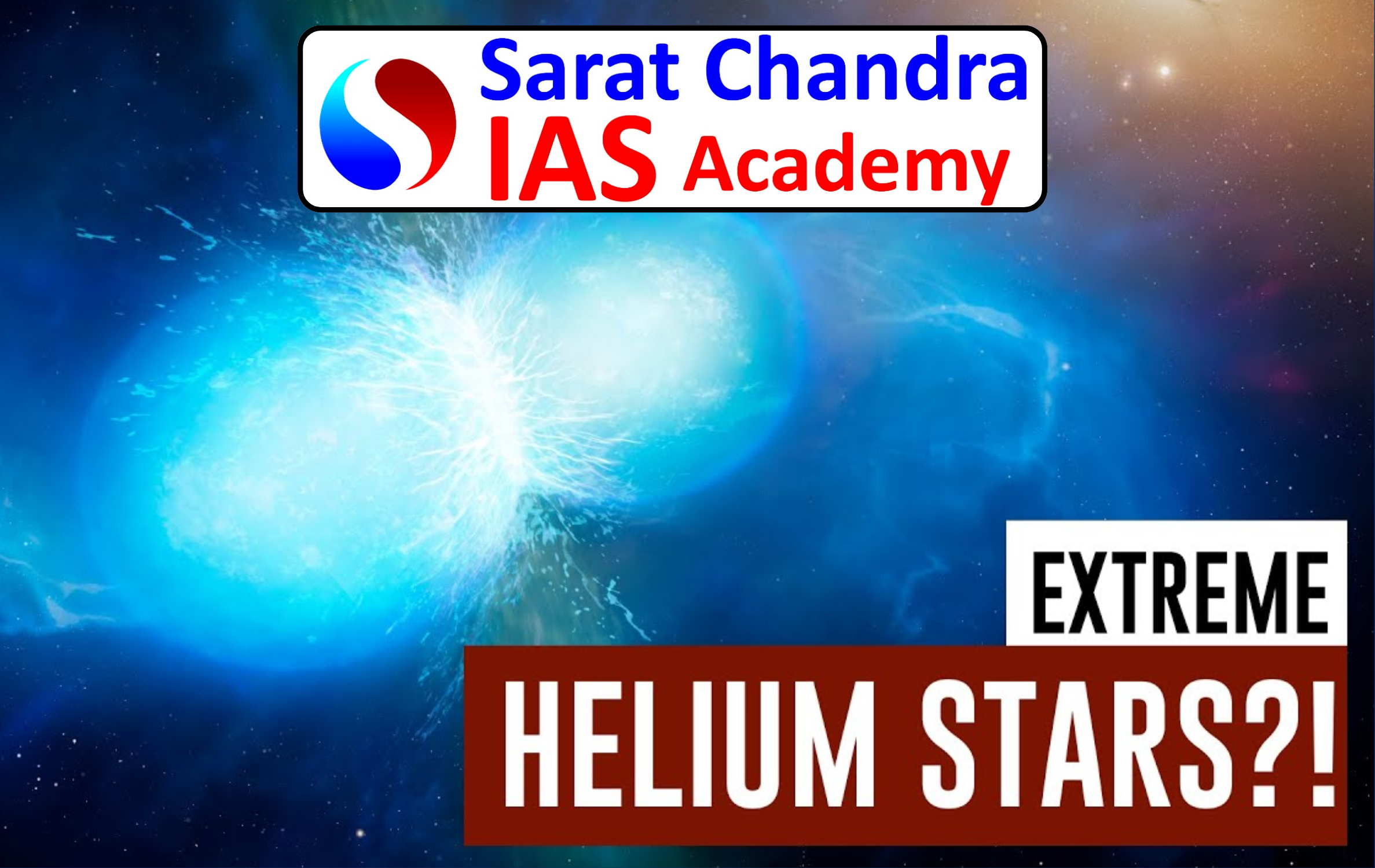
Extreme Helium Stars are believed to originate from the merger of a carbon-oxygen white dwarf with a less massive helium white dwarf.
Only 21 Extreme Helium Stars have been detected so far in our Milky Way Galaxy.
These stars have effective surface temperatures ranging from 8,000 Kelvin to 35,000 Kelvin.
The first Extreme Helium Star, HD 124448, was discovered in 1942 by Daniel M. Popper at McDonald Observatory, Austin, from the University of Chicago.
A980:
It is a rare Extreme Helium Star (EHe) located in the Ophiuchus Constellation, about 25,800 light-years from Earth.
Singly-ionized germanium (Ge II) lines were detected for the first time in any EHe star, specifically in A980.
Germanium in A980 was found to be eight times more abundant than in the Sun, indicating active stellar nucleosynthesis.